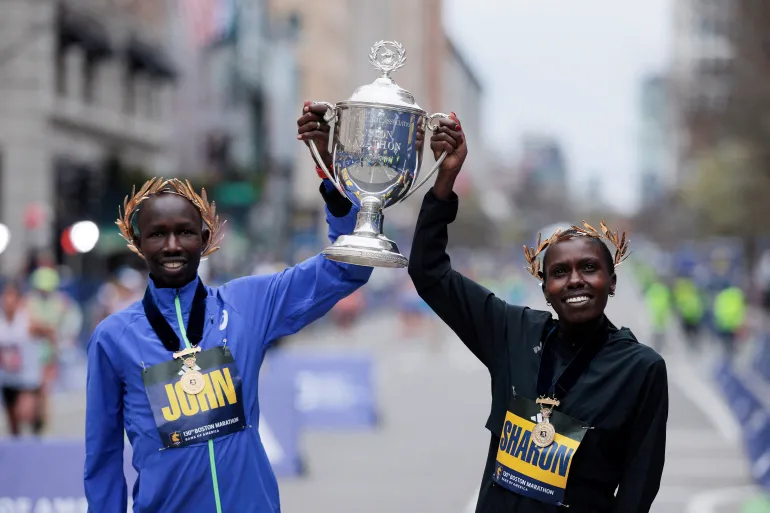
The Boston Marathon record fell in spectacular fashion as John Korir delivered a historic performance, while Sharon Lokedi secured a dominant victory to complete a Kenyan sweep. The 130th edition of the race produced one of the fastest days in its long history, aided by cool conditions and a strong tailwind.
Korir surged to victory in 2 hours, 1 minute and 52 seconds. As a result, he broke the long-standing course record set by Geoffrey Mutai in 2011. His time was 70 seconds faster than that mark. It also ranked as the fifth-fastest marathon ever recorded.
The Boston Marathon record performance unfolded with precision and control. Korir stayed with the lead pack through the early miles. However, he made his decisive move at the 20-mile mark. At that point, he surged past Ethiopia’s Milkesha Mengesha. From there, he ran alone for the final stretch.
Korir later revealed he sensed the pace but did not check the clock. Instead, he focused on maintaining rhythm and speed. Only after crossing the finish line did officials confirm the record. Boston Athletic Association president Jack Fleming delivered the news. As a result, Korir reacted with visible excitement.
“I knew I would defend my title,” Korir said. “But I didn’t know I could run that fast.”
The final miles highlighted the strength behind the Boston Marathon record run. Korir clocked his last mile in four minutes and 26 seconds. Moreover, he approached the finish with visible confidence. He smiled and celebrated even before crossing the line.
Behind him, the depth of the field became clear. Notably, the top three men all finished faster than the previous course record. This result underscored the exceptional pace set throughout the race.
Meanwhile, the women’s race delivered its own commanding display. Lokedi crossed the finish line in 2 hours, 18 minutes and 51 seconds. Although slower than her record-setting run the previous year, her performance still secured a clear victory.
The Boston Marathon record narrative extended into the women’s field through dominance rather than time. Lokedi controlled the race during its closing stages. With about five miles remaining, she faced pressure from Kenya’s Loice Chemnung. However, she responded with a powerful surge.
Lokedi increased her pace sharply in the final miles. She ran splits under four minutes and 50 seconds. As a result, she dropped her closest rival and pulled away decisively.
“I was just like, let me push it and see how it goes,” Lokedi said. “I left it all out there.”
The closing stretch confirmed Kenya’s dominance. Kenyan runners claimed the top four positions in the women’s race. In addition, American runner Jess McClain finished fifth. She recorded the fastest time ever by an American woman in Boston.
The race conditions played a crucial role in shaping the Boston Marathon record day. Temperatures hovered around 45 degrees Fahrenheit. The weather remained clear throughout the event. Most importantly, runners benefited from a tailwind that reached up to 10 miles per hour. These factors combined to create near-ideal racing conditions.
Even so, Boston remains a challenging course. Its rolling hills and unpredictable terrain test endurance and strategy. Therefore, breaking records on this course carries added significance compared to flatter races.
For context, the global marathon benchmark still belongs to Kelvin Kiptum. He set the world record of 2:00:35 in Chicago in 2023. That course is flatter and faster than Boston. As a result, performances in Boston often reflect strength and tactical execution more than pure speed.
Korir’s achievement adds to Kenya’s long legacy in distance running. It also strengthens his growing reputation on the global stage. Notably, he had already made history by winning alongside his brother in a previous edition. Now, he has added a record-breaking run to his achievements.
The Boston Marathon record performance signals a new era of competition. Athletes continue to push the limits of endurance and speed. At the same time, improved training methods and race strategies are raising performance standards.
Looking ahead, the question is how long this record will stand. Given the depth of talent in men’s marathon running, future challenges are inevitable. However, Korir’s run has set a high benchmark.
Ultimately, the race delivered both history and dominance. The Boston Marathon record fell, and Kenyan runners controlled both fields. As a result, the 130th edition will stand as one of the most memorable in the event’s history.