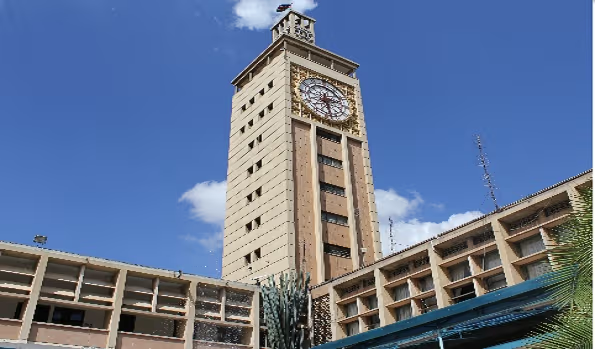
The Judicial Service Commission has nominated fifteen candidates for appointment as Court of Appeal judges. The list includes prominent figures Issack Hassan, chairperson of the Independent Policing Oversight Authority, and senior advocate Katwa Kigen. The JSC concluded a rigorous, competitive interview process on Wednesday. Consequently, the nominees now await presidential appointment. The commission emphasized principles of merit, integrity, and gender parity in its selection. This recruitment aims to significantly bolster the appellate court’s capacity from 27 to 42 judges.
The nomination of Hassan and Kigen is particularly notable. Hassan brings extensive experience from his role overseeing police conduct. Kigen is a seasoned lawyer known for representing high-profile clients, including President William Ruto. Their inclusion, alongside serving High Court judges and other advocates, reflects a deliberate blend of judicial and legal practice expertise. The JSC stated the expansion will ease case backlogs and improve access to justice. Therefore, this move addresses a critical need within Kenya’s judicial system.
The Full List of Nominees and Selection Criteria
The JSC released the complete list of fifteen nominees. It features several serving High Court judges and senior legal practitioners. The nominees are: Issack Hassan, Katwa Kigen, Justice Chacha Mwita, Lady Justice Hedwig Imbosa Ong’udi, Justice Mathews Nduma Nderi, Lady Justice Linnet Mumo Ndolo, and Lady Justice Lucy Mwihaki Njuguna. Also nominated are Justice Samson Odhiambo Okongo, Lady Justice Rachel Chepkoech Ngetich, Justice Stephen Andersen Radido Okiyo, Brown Murungi Kairaria, Paul Lilan, Justice Munyao Sila, Johnson Okoth Okello, and Justice Byram Ongaya.
The commission followed a transparent, multi-stage process. It began with public advertisement and included public participation before shortlisting. The interviews were live-streamed, allowing public scrutiny. The JSC assessed candidates on professional competence, communication skills, integrity, and sound judgment. Furthermore, legal experience and commitment to public service and constitutionalism were key metrics. This comprehensive approach aimed to select the most qualified individuals for the vital role of Court of Appeal judges.
Impact on the Court of Appeal and Judicial Efficiency
The appointment of fifteen new Court of Appeal judges will substantially increase the bench’s strength. The court’s complement will rise from 27 to 42 judges. This expansion is a direct response to a persistent backlog of appeals. A larger bench will allow for more panels to hear cases concurrently. Consequently, the speed of hearing and determining appeals should improve markedly. This is crucial for access to justice, as delays undermine public confidence in the legal system.
The infusion of new judges also brings diverse professional backgrounds. The mix of sitting judges and practicing lawyers enriches the court’s perspective. Serving judges offer deep experience in judicial reasoning and procedure. Practicing lawyers like Kigen and Hassan contribute fresh insights from the front lines of legal practice and oversight bodies. This diversity can lead to more robust jurisprudence. Ultimately, a larger, more capable appellate court strengthens the entire judiciary’s effectiveness.
Constitutional Procedure and Next Steps
The nomination is not the final step. The JSC will forward the names to President William Ruto for formal appointment. This is mandated by Article 166(1)(b) of the Constitution. The President’s role is largely ceremonial in this process, as the Constitution limits discretion once the JSC submits names. However, the appointment must be made promptly to avoid unnecessary delays in strengthening the court.
After appointment, the new Court of Appeal judges will be sworn in. They will then undergo orientation before assuming their duties. The Chief Justice will assign them to various stations across the country’s appellate circuits. Their deployment will likely consider existing caseloads and regional balance. The successful integration of these fifteen jurists will be a key test for judicial administration. Their performance will be closely watched by the legal community and the public.
Broader Implications for Kenya’s Judiciary
This mass appointment signals a commitment to addressing systemic challenges within the judiciary. Chronic understaffing has long hampered efficiency. By nearly doubling the appellate bench’s potential size, the government and JSC are taking concrete action. This move could set a precedent for similar expansions in other overburdened courts, like the High Court and magistrates’ courts.
The transparent process also reinforces judicial independence. By conducting live-streamed interviews and emphasizing merit, the JSC builds public trust. It demonstrates that judicial appointments can be insulated from undue political influence. The inclusion of figures like Hassan, who leads a police oversight body, underscores the judiciary’s role as a check on other branches of government. As these new Court of Appeal judges assume office, they carry the responsibility of upholding this standard of integrity and excellence.