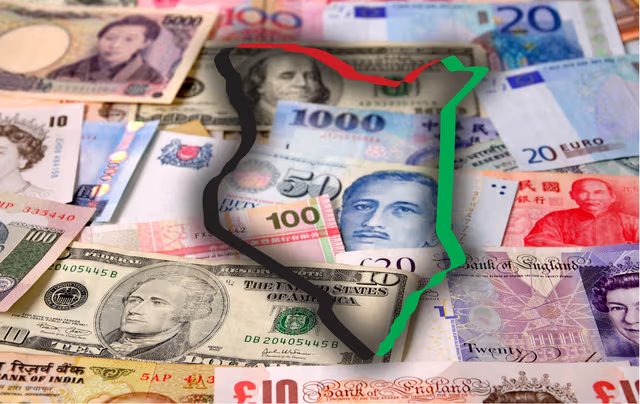
Global recession risk is rising sharply as escalating tensions in the Middle East continue to disrupt energy markets. As a result, the International Monetary Fund has warned that prolonged conflict could push the world economy toward a downturn.
In its latest World Economic Outlook report, the IMF outlined a worst-case scenario. It stated that global growth could fall below 2 percent by 2026 if oil, gas, and food prices remain elevated. Such a slowdown would bring the world close to a recession, a rare event that has occurred only a few times since 1980.
The warning comes as the US-Israel war with Iran continues to affect global supply chains. Energy prices surged after the conflict disrupted key shipping routes. In particular, the Strait of Hormuz has seen reduced traffic, which has tightened supply.
Consequently, oil prices have climbed sharply. At one point, crude prices approached $120 per barrel before easing slightly. On Tuesday, oil traded near $98.85 per barrel. However, the IMF warned that prices could average $110 this year and rise to $125 by 2027 under severe conditions.
If this trend continues, inflation could accelerate. The IMF estimates that global inflation may reach 6 percent next year. Therefore, central banks may respond by raising interest rates to control price growth. This move could slow economic activity further.
The global recession risk depends heavily on how long the conflict lasts. If the war continues into next year, economic pressures will likely intensify. In contrast, a quick resolution could stabilize markets and support recovery.
The IMF provided a more optimistic scenario as well. If the conflict ends within weeks and energy production resumes, global growth could reach 3.1 percent in 2026. Although this figure remains below earlier forecasts, it suggests a manageable slowdown rather than a crisis.
Even so, the impact varies across regions. Among advanced economies, the United Kingdom faces the greatest challenge. The IMF has lowered its growth forecast for the UK to 0.8 percent this year. However, it expects the economy to recover slightly in the following year.
Meanwhile, oil-exporting nations in the Gulf face mixed outcomes. Some countries could see growth slow sharply or even contract. For instance, the IMF expects Iran’s economy to shrink by 6.1 percent this year. However, it projects a rebound if the conflict ends soon.
Qatar has also felt the impact. The country’s Ras Laffan facility, the world’s largest liquefied natural gas refinery, has suffered damage. As a result, the IMF predicts Qatar’s economy will contract by 8.6 percent in 2026 before recovering later.
In contrast, Saudi Arabia shows more resilience. Its East-West pipeline allows it to bypass the Persian Gulf and maintain exports. Therefore, its economy is expected to grow by 3.1 percent in 2026 and accelerate further the following year.
The global recession risk also depends on infrastructure stability. Countries with alternative export routes and stronger systems can better withstand disruptions. On the other hand, those heavily reliant on the Strait of Hormuz face greater vulnerability.
Interestingly, some economies have benefited from rising oil prices. The IMF expects Russia’s economy to grow by 1.1 percent this year and next. This outlook follows policy changes by Donald Trump, who lifted certain restrictions on Russian oil exports as prices surged.
In addition, the United States temporarily eased sanctions on Iranian oil exports. This move aimed to stabilize supply and reduce price pressure in global markets. However, the long-term impact remains uncertain.
Looking ahead, the global recession risk will hinge on key developments. These include the duration of the conflict, the stability of energy infrastructure, and the response of global policymakers. Each factor will shape the trajectory of growth and inflation.
In conclusion, the IMF’s warning highlights a fragile global economy. While a resolution could restore stability, prolonged conflict may deepen economic strain. As uncertainty continues, the global recession risk remains a central concern for markets and policymakers alike.