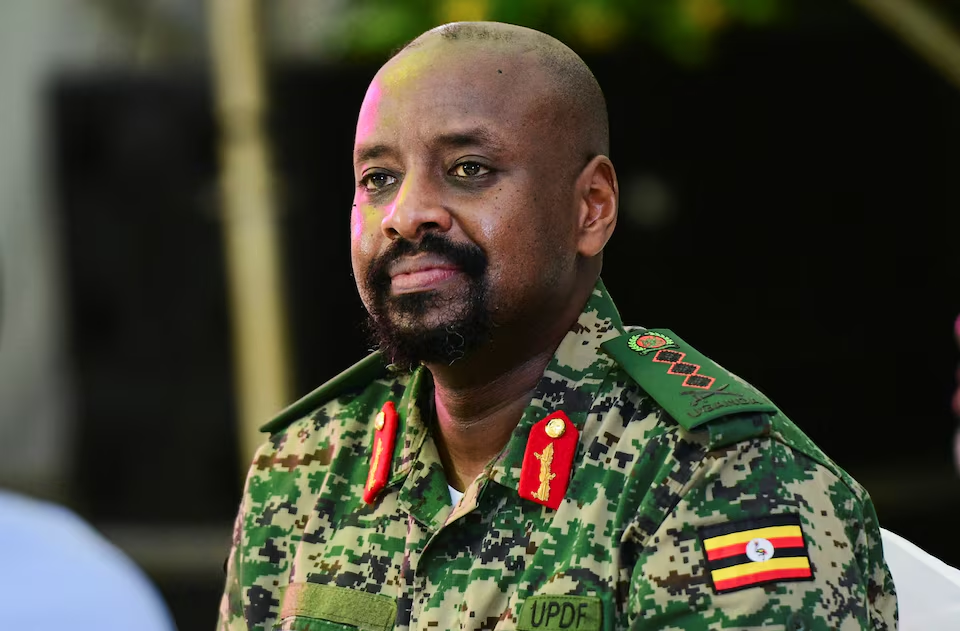
Uganda army chief Muhoozi Kainerugaba has publicly denied allegations that soldiers assaulted the wife of opposition leader Bobi Wine. The military leader dismissed the claims in a post on social media platform X. Opposition figure Robert Kyagulanyi, known as Bobi Wine, alleged troops raided his Kampala home overnight. He stated the soldiers attacked staff and choked his wife, Barbara Kyagulanyi, necessitating medical treatment. Consequently, the Uganda army chief stated the military “do not beat up women” and were instead searching for Wine himself. This incident intensifies existing political tensions following Uganda’s disputed presidential election. Furthermore, it underscores the ongoing conflict between the state and its political opposition.
Details of the Alleged Incident and Denial
Bobi Wine provided a detailed account of the alleged raid on his residence in the Magere suburb of Kampala. He reported that soldiers broke into his home overnight into Saturday, assaulting household staff during the operation. Wine specifically accused the troops of choking his wife, Barbara Kyagulanyi, an act that forced her to seek subsequent medical attention. The opposition leader confirmed he was not present at home during the incident, having been in hiding since the January election. In response, Uganda army chief Muhoozi Kainerugaba issued a categorical denial on his official X account. He stated the allegations were “not worth our time” and emphasized the army’s search was for Wine, whom he called “cowardly,” and not his wife. This exchange represents a direct confrontation between the military establishment and the opposition.
Political Context of the Disputed Election
The allegation occurs against a backdrop of severe political strife following Uganda’s January 15 presidential vote. Incumbent President Yoweri Museveni was declared the winner with 71.6% of the vote, extending his nearly four-decade rule. Bobi Wine, who finished second, has forcefully rejected the results, citing widespread fraud and electoral irregularities. Since the election, Wine and his supporters have reported persistent harassment and intimidation by state security forces. Human rights groups have long accused Museveni’s government of utilizing the military and police to suppress political dissent and opposition activities. The government consistently denies these accusations, framing its actions as necessary for maintaining law and order. The alleged raid on Wine’s home fits a pattern of post-election crackdowns described by independent observers.
The Role of Muhoozi Kainerugaba as Uganda Army Chief
Muhoozi Kainerugaba holds a uniquely powerful position as both the head of Uganda’s military and the son of President Yoweri Museveni. His direct, confrontational communication style on social media is a notable feature of Uganda’s political landscape. By personally responding to Wine’s allegations, he places the military at the center of a political dispute. His statement that soldiers were “looking for her cowardly husband” explicitly confirms an active military pursuit of the opposition leader. This direct involvement blurs the lines between state security operations and political contests. Analysts view Kainerugaba’s rising profile and control of the army as central to discussions about political succession in Uganda. His actions directly influence the perceived neutrality and role of the armed forces in civil society.
International Reaction and Human Rights Concerns
The incident will likely draw further international scrutiny to Uganda’s human rights record. Global rights organizations have repeatedly documented cases of alleged torture, enforced disappearances, and extrajudicial killings by state security agents targeting government critics. The alleged assault on a high-profile political figure’s family member represents a significant escalation. Such actions often trigger statements from foreign embassies and international bodies calling for restraint and independent investigations. However, the Ugandan government has historically dismissed external criticism as interference in its domestic affairs. The government’s response to this specific allegation will be closely monitored for its implications on diplomatic relations, particularly with Western nations that provide substantial development aid.
Impact on Uganda’s Opposition and Civil Society
For Bobi Wine’s National Unity Platform and the broader opposition, the alleged raid signifies intensifying pressure. The targeting of a leader’s family may be intended to demoralize supporters and signal the state’s reach. It creates an environment of fear that can stifle political mobilization and public dissent. Civil society organizations operating in Uganda already work under restrictive laws limiting their activities. Incidents like this reinforce the risks associated with challenging the ruling party. The opposition’s ability to document and publicize such events internationally remains a key strategy for seeking accountability. However, within Uganda’s borders, the space for peaceful political activity appears to be contracting further, according to local human rights defenders.
Legal and Accountability Mechanisms in Uganda
The allegation poses a significant test for Uganda’s legal and accountability frameworks. In theory, the victim could file a formal complaint with the police or bring a civil case against the state. However, the judiciary’s independence is frequently questioned by opposition figures and international observers. The fact that the alleged perpetrators are soldiers complicates matters, as they may fall under military jurisdiction. Past attempts to seek legal redress for alleged abuses by security forces have often been delayed or dismissed. The public denial by the Uganda army chief himself suggests a high-level dismissal of the claim, potentially prejudicing any internal military investigation. This scenario highlights the challenges of achieving accountability when allegations involve the highest levels of the security command.
The denial by Uganda army chief Muhoozi Kainerugaba leaves a stark standoff between military authority and opposition claims. The alleged assault on Bobi Wine’s wife, if proven, represents a severe violation of personal security and political rights. Conversely, the military’s flat denial underscores its refusal to acknowledge any misconduct. This event deepens the political crisis stemming from the disputed election, eroding trust in state institutions. The international community faces renewed questions about how to respond to allegations of abuse in a strategically important nation. Ultimately, the incident exacerbates Uganda’s political polarization, moving the nation further from a peaceful resolution of its deep-seated political conflicts. The safety of opposition members and the principles of democratic engagement hang in the balance.